


The Impact of the Discount Rate on Insurance Technical Provisions
Outstanding claims reserves, SEDDK's fixed discount rate and the risk-free yield curve: how do different discounting approaches affect insurers' financial statements?
Read articleWe deliver actuarial software solutions for your digital compliance journey.
 GEwend
Turn day-long actuarial processes into minutes.
Make the calculation logic and key drivers behind every model's output visible.
Enterprise-grade data security and regulatory compliance standards.
Ongoing technical support from our experienced actuarial team.
Faster calculations, more transparent models, and more reliable results with Actuarial Intelligence.
GEM, BTM and more
With the Yield Curve Calculation System (GEM) and the Bodily Injury Compensation Calculation System (BTM), make your actuarial calculations fast, transparent and auditable.
Explore the productsExpert support in your actuarial processes
Tailored to your organisation, we deliver tangible outcomes and, rather than classic consulting, help you build capability.
GEwend models combine classic GLM/GAM approaches with modern machine learning techniques. See exactly what drives every prediction, with full traceability for regulators and internal audit.
We analyze your actuarial data with AI-assisted models so you can spot patterns and risks faster.
Forecast and manage insurance risks with distinctive algorithms.
Interactive dashboards continuously updated with live data.
Generates TFRS 17-compliant discount curves daily using AI-powered models.
The Yield Curve Calculation System (GEM) produces the market-based discount curves required by the TFRS 17 standard, powered by AI models. Filling the critical gap left when the European Insurance Authority (EIOPA) stopped publishing Turkish Lira-based yield curves, GEM combines internationally recognized methods such as Smith-Wilson and Nelson-Siegel-Svensson with AI to deliver auditable, regularly updated yield curves built for Turkish market conditions.
You can now produce the discount rates behind your technical reserve calculations in-house, with full transparency, without costly external consultancy. At a mid-sized insurer, for example, a change in discounting approach alone can create a financial impact of approximately 1.5 billion TRY on technical reserves — GEM delivers this critical input in seconds, audit-ready and fully compliant.
Cuts bodily injury calculations down to minutes — up to 95% time savings.
The Bodily Injury Compensation Calculation System (BTM) digitizes the calculation of bodily injury claims end-to-end, particularly for motor third-party liability insurance. Using TRH-2010 and TÜİK life tables, varying technical interest rates, negligence scenarios, and disability assumptions, it performs complex bodily injury calculations — including loss of support, permanent and temporary disability — in a standardized, consistent, and auditable way.
Calculations that used to take hours per file and depend on expert judgment now take minutes with BTM — up to 95% time savings, freeing your team for higher-value work. Able to batch-analyze thousands of files under different scenarios, BTM improves reserve accuracy, reduces risk, and directly feeds your pricing decisions.
This product was developed with the support of the TÜBİTAK-TEYDEB 1812 Investment-Based Entrepreneurship Support Program (Project No: 2260047). However, all responsibility for the product/service rests with GEWEND AKTÜERYAL TEKNOLOJİ VE YAZILIM A.Ş.
Temporary, permanent, caregiver, and loss-of-support calculations; Word reports; team and actuary approval.
See the compensation figure in minutes — in client meetings, before any offer.
For firms and teams that generate reports and archive their files.
For high-volume claims operations and institutions.
Optional modules you can add to any package for an extra fee.
Monthly message quota; extra packs available once used up
No quota; you pay your own AI provider directly
A one-off report without moving to Pro
For firms that want batch calculations without moving to Enterprise
Reviewed and signed off by a GEWEND actuary
Included in Enterprise
On Basic you see the result and the report preview on screen. You can add Word reports one at a time, or move to Pro for unlimited reports.
Yes. As your needs grow you can move up at any time; your data and settings carry over unchanged.
The calculation engine is tested against thousands of sample results on every release; the same file always produces the same figure.
Names and form data are stored encrypted. Only the people you authorize at your company can see your data. Enterprise offers a self-hosted deployment option.
No — it's an add-on for Pro and Enterprise. There are two options: our AI (with a monthly message quota) or your own Claude, Gemini, or ChatGPT account (no quota).
Full names and national ID numbers are masked before anything is sent; conversations are not stored.
Enterprise includes a contract, a data-processing agreement, and invoicing matched to your procurement process.
Smith-Wilson and Nelson-Siegel-Svensson, AI-assisted; an IFRS 17-aligned TRY yield curve; methodology report; team and actuary approval.
Inspect the current TRY discount curve on screen — for first assessments and small teams.
For actuaries and finance teams who generate curves and document their assumptions.
For companies with recurring reporting, multiple portfolios and enterprise integration needs.
Optional modules you can add to any package for an extra fee.
Monthly message quota; curve interpretation and assumption suggestions
No quota; you pay the AI bill to your own provider
A one-off report without moving to Pro
Batch curve generation for past valuation dates
For those who want scenario analysis without moving to Enterprise
A GEWEND actuary reviews and approves
Included in Enterprise
Internationally recognized methods such as Smith-Wilson and Nelson-Siegel-Svensson are combined with AI-assisted models. The method and assumptions are clearly documented in the report for every curve.
Yes. GEM is designed to produce the market-based discount curves that IFRS 17 requires for the Turkish lira; the method and assumption documentation is audit-ready.
In Basic and Pro you generate the curve for any date you choose. In Enterprise you can schedule automatic updates daily, weekly or at period-end.
In Pro and Enterprise you can adjust assumptions such as UFR, convergence speed and liquidity premium, and compare results across methods.
Yes. As your needs grow you can move up at any time; your data and settings carry over unchanged.
Data is stored encrypted. Only people you authorize can see your company's data. Enterprise offers an on-premise installation option.
Enterprise includes a contract, a data-processing agreement and invoicing suited to your procurement process.
From appointed actuary duties to TFRS 17 work, from capital adequacy to expert witness services, we provide actuarial services under one roof.
We carry out the appointed actuary role required by regulation in non-life, life and pension companies.
Services for your institution's actuarial needs, from provision calculations to TFRS 17 and from capital planning to pricing work.
Preparation of actuarial valuation reports suitable for audit.
Review of existing actuarial work; technical opinions on disputes and bodily injury files.
We provide actuarial expert services before the Insurance Arbitration Commission on life insurance and non-life bodily injury compensation calculations.
We provide consulting services for your needs in the actuarial field. Tailored to your organisation, we deliver tangible outcomes and, rather than classic consulting, help you build capability.
Preparation, review and reporting of technical provision and reserve calculations in line with the relevant regulation and actuarial standards.
Support for TFRS 17 implementation: process design, modelling, assumption management, documentation and reporting.
Building tariff and pricing models, product design, profitability analyses and review of pricing processes.
Setting actuarial assumptions, experience analyses, model development, validation and review of results.
Advanced actuarial models and calculations for life and non-life insurance products.
Dynamic models for optimal pricing strategies and competitive market analysis.
Solvency II and IFRS 17-aligned risk models and capital adequacy analyses.
On IFRS 17, claims and compensation, AI and actuarial technology — notes from the field, from practice and from our team's experience.
Outstanding claims reserves, SEDDK's fixed discount rate and the risk-free yield curve: how do different discounting approaches affect insurers' financial statements?
Read articleThe discount rate behind technical provisions is not just an input — it is one of the most sensitive levers on the balance sheet. Who should produce the curve, with which method, and how transparently?
Read articleCompensation figures shift as life tables, technical interest, fault and disability assumptions change. Without a standard approach, explaining those differences gets hard.
Read articleAI models can produce powerful predictions, but in a regulated field a model that cannot answer 'why did it give this result?' often cannot be used at all.
Read articleIn a short call with our team we will listen to your needs and pin down the right solution together.
Outstanding claims reserves, SEDDK's fixed discount rate and the risk-free yield curve: how do different discounting approaches affect insurers' financial statements?
The value of the technical provisions on an insurer's balance sheet depends not only on the expected future payments but also on the discount rate used to determine their value at the calculation date. When the same series of cash flows is discounted at a different rate, the reported provisions – and therefore the financial results – can change considerably. How the discount rate is derived, what value it takes at different maturities and how often it is updated have therefore become as important as the actuarial assumptions themselves.
In this article we first summarise how the discount rate is set in the international framework. We then turn to practice in Türkiye: we compare the fixed discount rate set by the Insurance and Private Pension Regulation and Supervision Agency (SEDDK) for outstanding claims reserve calculations, and its changes over time, with a risk-free yield curve based on benchmark assets traded in the financial markets, and examine how different rates affect insurers' financial statements.
The idea of calculating the present value of insurance liabilities with a risk-free yield curve began with the Solvency regimes. It gained far greater importance with the move to IFRS 17, the standard that determines financial reporting results. IFRS 17 requires discount rates to reflect the timing and currency characteristics of the cash flows of insurance liabilities; it does not prescribe a specific method for setting the discount rate, but it does lay down its principles. In practice there are two main approaches:
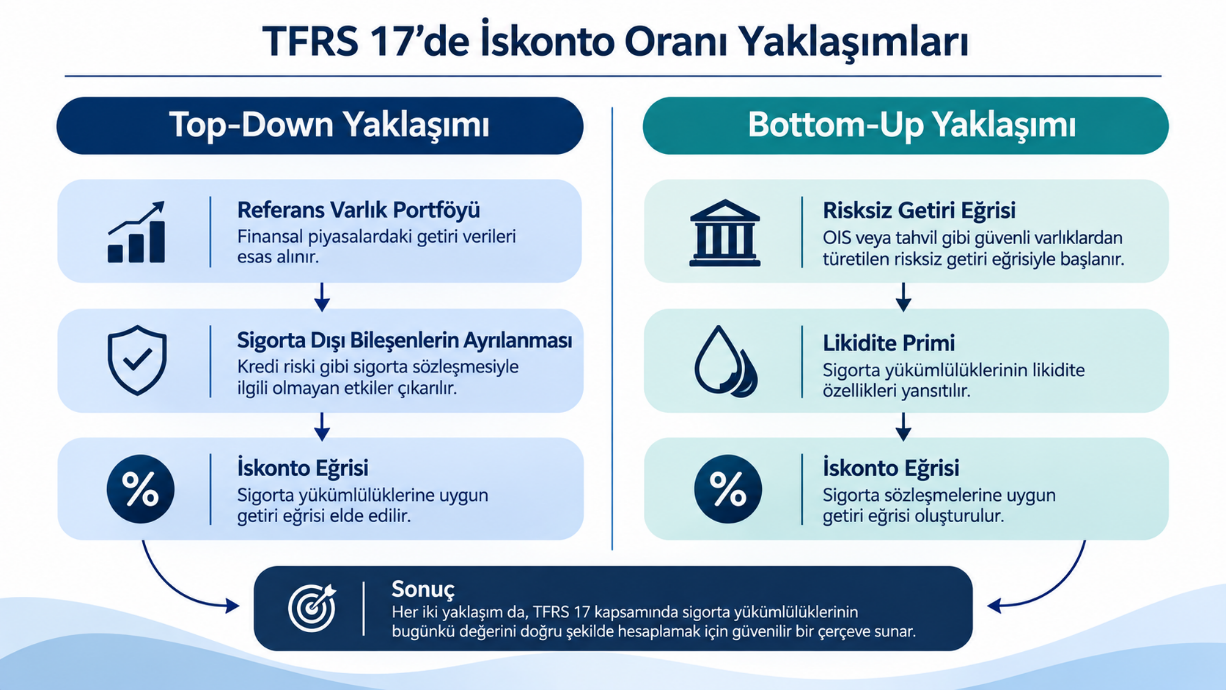
Under Solvency II, EIOPA produces risk-free yield curves for the currencies of the countries in scope using the Smith-Wilson method and publishes them monthly in Excel format. For each currency, the curve is estimated from market data up to the last maturity that can be observed in a deep and liquid market (the last liquid point, LLP); beyond this point, in the extrapolation region, the curve is made to converge over a set period towards a long-term ultimate forward rate (UFR). The long end of the curve is therefore driven by the mathematical model rather than by market data. On top of the risk-free curve, elements such as the Credit Risk Adjustment – which reflects features of the underlying financial instruments that are not part of the insurance liability – and the Volatility Adjustment, which reflects temporary market fluctuations, are also taken into account in setting the final discount rate.
In Turkish insurance regulation, discounting was first applied in 2016 to estimate outstanding claims reserves in the liability lines, using a flat 9% for all maturities – the statutory interest rate, which the courts also applied at the time. Following later amendments, the rate is updated directly by SEDDK in line with market conditions, but it is still set as a single rate for every maturity. For 2026, SEDDK has announced the latest rate as 29%.
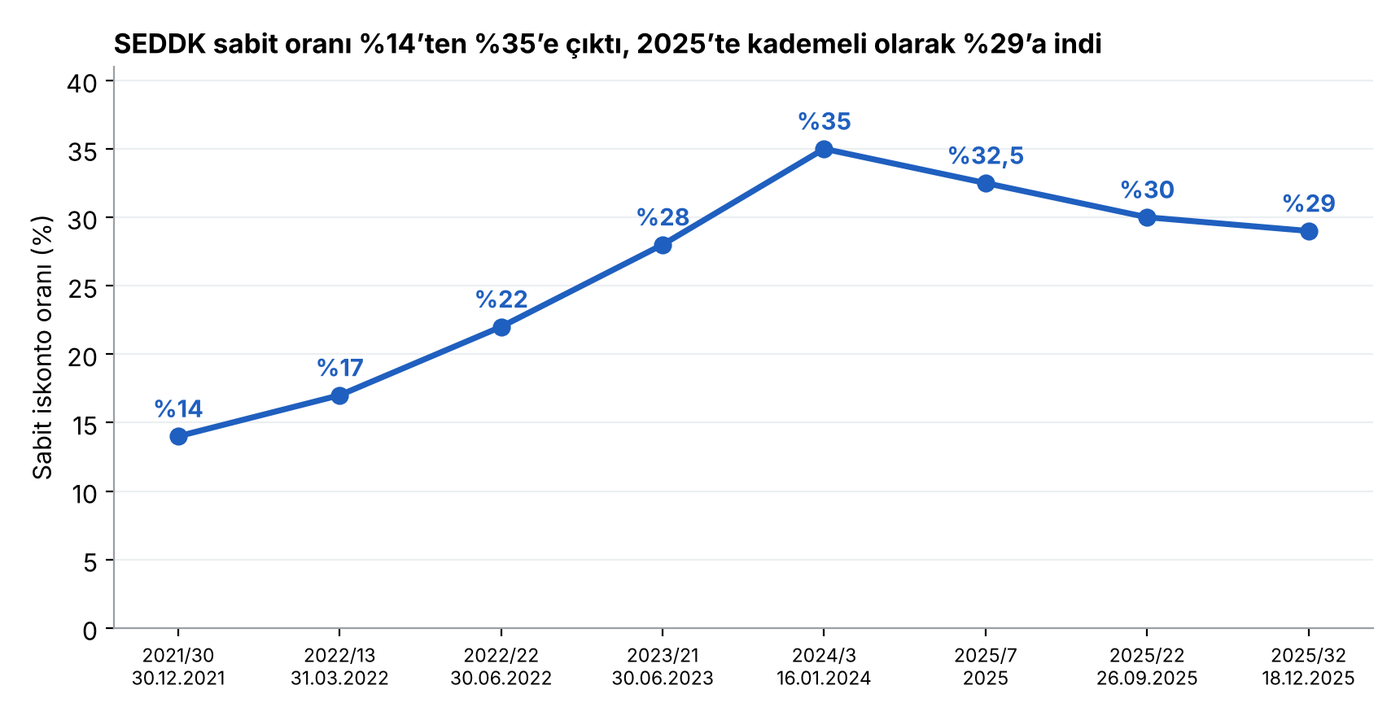
However, applying one fixed rate to every maturity of the cash flows leads to different financial results than discounting with a yield curve consistent with observed market conditions, as under IFRS 17. Using the same rate for every period moves away from an economic valuation that reflects the time risk at different maturities: a payment due in one year and a payment due in eight years are discounted at the same rate. Secondly, the rate is announced through circulars at irregular intervals, so market conditions between regulatory updates are not captured.
When a yield curve estimated from current market conditions using the international methodology is compared with the fixed 29% rate, market-based spot rates are seen to lie above 29%, particularly over the first 10 years.
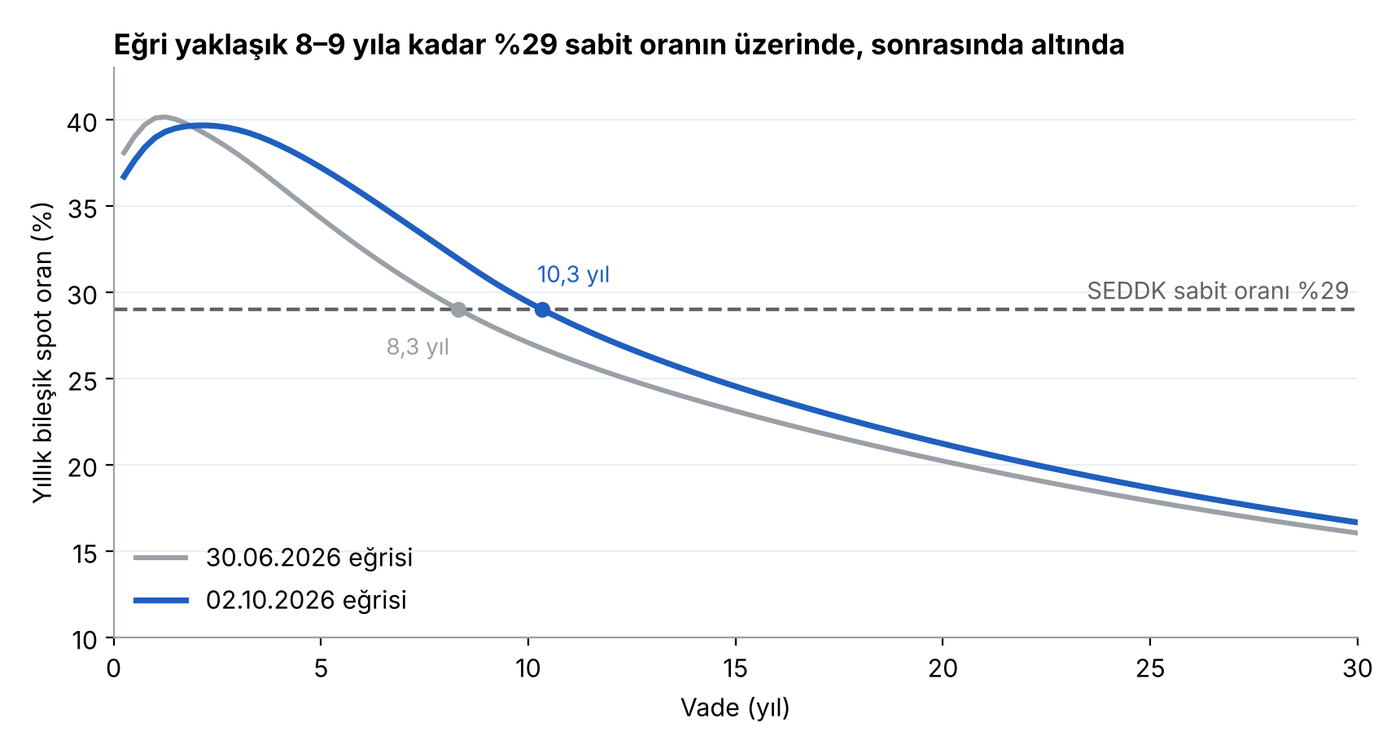
The yield curve estimated from market data as of 02.10.2026 produces spot rates of 39% at year 1, 37% at year 5 and 31% at year 9. When the curve produced from market data at a different observation date, 30.06.2026, is compared with the fixed 29% rate, the curves converge to this rate between years 8 and 10, and beyond 10 years they produce spot rates below the fixed rate.
Developments in Turkish financial markets, which unfold at different speeds across short maturities, also need to be followed closely. The curves for 30.06.2026 and 02.10.2026 produce different spot rates and therefore have different effects on financial results. Over the June–October 2026 period under review, short-term spot rates fell in line with the Central Bank's interest rate policy, while at medium and long maturities economic developments raised perceived risk and investors demanded higher yields in return.
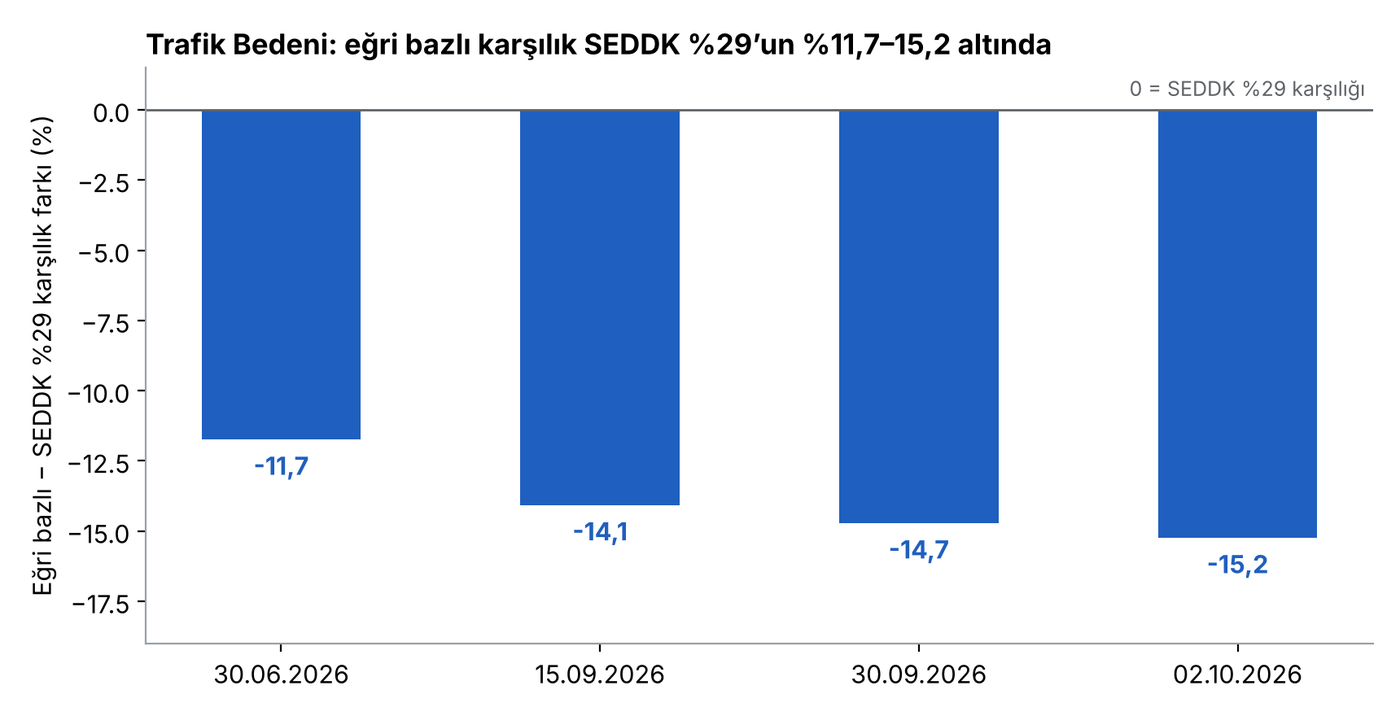
In compulsory motor third-party liability (MTPL) insurance – one of the long-tailed liability lines – a substantial part of bodily injury payments is made in years 2 to 4 after the accident, with payments spread over 15 years at a decreasing rate; companies calculate their outstanding claims reserves in line with this pattern. For the sample dates between 30.06.2026 and 02.10.2026, the present value of the cash flows based on yield curves produced with GEM from current market data is 11% to 15% lower than under the fixed 29% rate. (The liquidity characteristics of the line were assessed separately.)
Beyond calculating the present value of technical provisions in insurance, risk-free yield curves are an important forecasting and calculation tool in many areas with long-dated cash flows, such as banking, fund management, and infrastructure and engineering project valuation.
Key uses include: comparing the maturity and cash flow profiles of assets and liabilities and projecting interest income in asset-liability management; measuring interest rate risk in the banking book; discounting cash flows at maturity-appropriate rates for products such as bonds, loans and credit life insurance; building scenarios, running stress tests and calibrating interest rate models in financial risk management; present value analysis of long-term investments such as energy and infrastructure that takes the maturity structure of cash flows into account; and actuarial pricing of pensions and other long-term liabilities.
Building the yield curve with consistent mathematical methods, being able to reproduce it from historical data, and reporting every step of the production process in an auditable way are also key points to observe in practice.
The discount rate is one of the core assumptions in technical provision calculations. For claims payments that extend over long periods in particular, the structure of the payment pattern – not only the discount rate – has a significant effect on the present value of the provision.
Using a fixed discount rate simplifies the calculation, but it does not directly reflect interest rates at different maturities or changes in market conditions. A yield curve–based calculation, by contrast, uses the spot rate for each maturity, so the present value of the cash flows better reflects the current financial situation and allows a more detailed valuation of liabilities.
The difference between the fixed-rate approach and the yield curve–based calculation depends on the payment pattern, the valuation date and the characteristics of the curve used. It is therefore important not only to calculate the difference at a single date but also to monitor how it changes under different market conditions.
Especially in long-tailed liability lines, measuring the effect of discounting assumptions on provisions using the company's own payment data helps assess financial results more soundly.
GEM (Yield Curve Engine) is our module for building the Turkish risk-free yield curve in line with international standards and monitoring it daily. Model parameters such as the last liquid point, the ultimate rate and the convergence period can be viewed and changed by the user. Additional components such as the credit risk adjustment and the volatility adjustment can be handled separately depending on the methodology and use case, and calculations run in seconds. This approach helps actuarial, finance and risk management teams work within the same data and methodology framework.
The impact of using a yield curve on technical provisions varies with each company's portfolio structure and payment characteristics. A result obtained for the market as a whole may therefore not have the same effect for every company.
A company-level analysis can look for answers to questions such as:
With GEM, these questions can be examined using the company's own data and chosen assumptions. Contact us to assess GEM's impact on your company's portfolio or to arrange a technical discussion on yield curve methodology.
In a short call with our team we will listen to your needs and pin down the right solution together.
The discount rate behind technical provisions is not just an input — it is one of the most sensitive levers on the balance sheet. Who should produce the curve, with which method, and how transparently?
IFRS 17 requires insurance liabilities to be valued using market-based discount curves. In practice, no matter how well your cash flows are modelled, the result depends heavily on the discount curve you place underneath them.
For long-dated liabilities, a small rate difference creates a visible deviation in present value. For a mid-sized insurer, a change in discounting approach alone can move technical provisions by roughly TRY 1.5 billion.
The discount curve looks like an accounting input, but it is really an actuarial decision.
Internationally recognized methods such as Smith-Wilson and Nelson-Siegel-Svensson each have their own strengths and weaknesses. Which one is chosen matters, but so do the assumptions it runs on (ultimate forward rate, convergence speed, liquidity premium) — and both must be traceable for auditors and management.
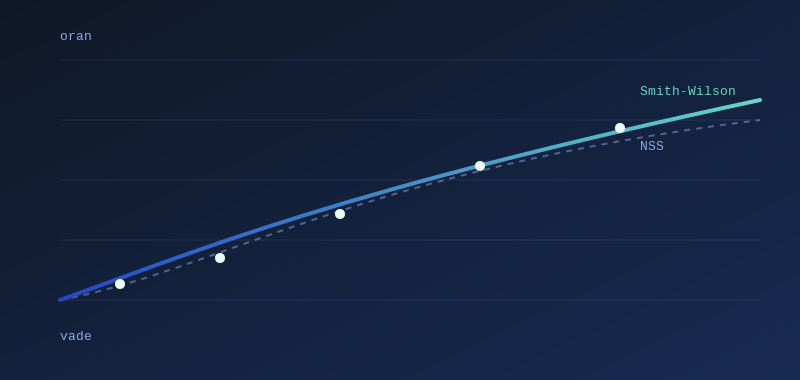
| Feature | Smith-Wilson | Nelson-Siegel-Svensson |
|---|---|---|
| Approach | Fits observed maturities exactly | Fits a smooth parametric curve |
| Long end | Converges to the ultimate forward rate | Depends on the parameters |
| Strength | Fidelity to market data | Simple, few parameters |
With TRY-based curves no longer available on a regular basis from external sources, companies are being pushed to produce their own. The goal is a fast, repeatable and audit-ready process. The Yield Curve Calculation System (GEM) was built for exactly this need.
In a short call with our team we will listen to your needs and pin down the right solution together.
Compensation figures shift as life tables, technical interest, fault and disability assumptions change. Without a standard approach, explaining those differences gets hard.
In motor third-party liability insurance, bodily injury files are complex calculations where many assumptions meet. The choice of TRH-2010 or TÜİK life tables, the technical interest rate, the fault ratio and the disability assumption all feed directly into the result.
Two experts calculating the same file can arrive at different figures. Most of the time the cause is not an error but different assumption sets and manual intermediate steps.
Running the calculation through a standard engine makes results auditable and repeatable. Work that takes hours per file drops to minutes, and the team can spend time on higher-value tasks such as reserve accuracy and pricing.
Speed matters, but the real value is applying the same rules in the same way on every file.
In a short call with our team we will listen to your needs and pin down the right solution together.
AI models can produce powerful predictions, but in a regulated field a model that cannot answer 'why did it give this result?' often cannot be used at all.
Actuarial work must not only be correct; it must be defensible. A result is valuable when it can be explained to an auditor, a regulator or a board.
A model can perform very well on historical data, but if it is unclear how inputs drive the result, it is also impossible to foresee what happens when assumptions change.
At GEWEND we place AI alongside actuarial methods, not in place of them: we build on established methods and use AI to speed up and enrich them. The result is a process that is fast, yet explainable at every step.
In a short call with our team we will listen to your needs and pin down the right solution together.
We are launching a new era of actuarial technology. By combining actuarial expertise with advanced analytics and artificial intelligence, we are transforming actuarial calculation and modeling into a more dynamic, transparent, explainable, and powerful decision science. As GEwend, we are leading the evolution of actuarial intelligence, building a world where technology reshapes the future of the actuarial profession.
We are turning actuarial intelligence into an accessible, reliable, and continuously evolving technology. We digitize complex actuarial processes end-to-end, bringing together advanced analytics, AI, and actuarial expertise to deliver fast, dynamic, transparent, explainable, and regulation-compliant results. At the same time, we grow our knowledge and technology base to help build the next generation of actuarial competencies and strengthen the field's expert workforce.
We are Turkey's pioneering and reference brand in actuarial intelligence. We do not just digitize actuarial technology - we transform how the field works. We bring Turkey's strong actuarial knowledge base together with advanced technology; as a homegrown technology brand, we are expanding the boundaries of the actuarial profession and leading an actuarial technology ecosystem that reaches from Turkey to the world.
Bahcelievler Mah. 323/1 Cad. C Blok
Gazi University Teknokent Building No: 10/50C, Gölbaşı / ANKARA
info@gewend.com
0507 868 57 93
0531 583 99 57